Subterranean termite treatments in Wilmington address the common Eastern subterranean termite (*Reticulitermes flavipes*), an organism that nests in native Delaware soils and requires continuous ground moisture to…
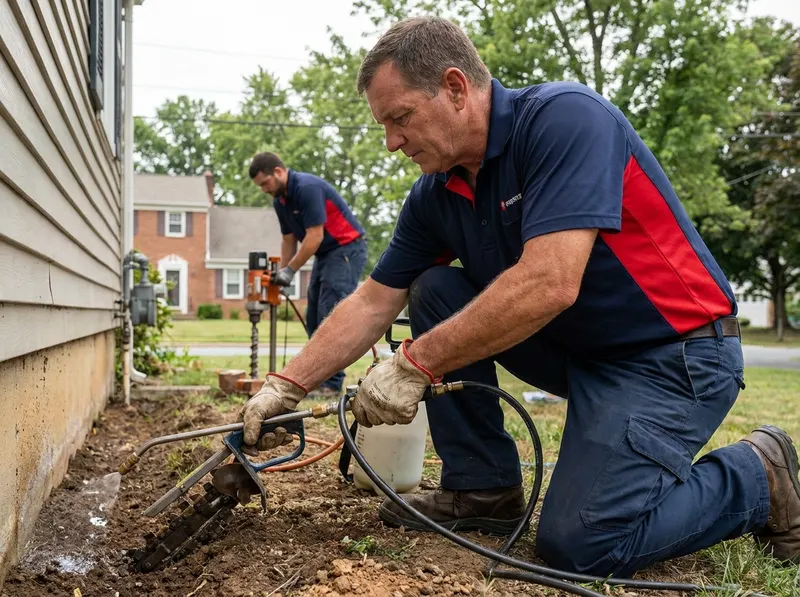
Subterranean termite treatments in Wilmington address the common Eastern subterranean termite (*Reticulitermes flavipes*), an organism that nests in native Delaware soils and requires continuous ground moisture to survive. Historic residential architecture across older neighborhoods, such as rubble-stone foundations in Trolley Square, Highlands, and Quaker Hill, or brick piers common in Forty Acres and Cool Spring, creates concealed entry paths. Termites build vertical shelter mud tubes across subterranean foundation walls, masonry cracks, and sill plates, often reaching the interior framing unnoticed until structural damage or spring swarming occurs.
Treatment selection balances liquid barrier installations against targeted in-ground baiting systems. A continuous non-repellent liquid barrier (applied by trenching soil 6 inches deep and rodding down to footings at a standard rate of 4 gallons per 10 linear feet) provides immediate lethal interception as workers traverse treated soil back to the central nest. In locations with deep flagstone footings, paved lot lines, or radiant heating pipes, frequently encountered along Delaware Avenue and Baynard Village properties, liquid trenching faces physical barriers. In these scenarios, cellular baiting stations installed at 10-foot intervals provide colony elimination via active insect growth regulators without requiring masonry disruption. The clear trade-off is time versus disruption: continuous liquid termiticides arrest feeding within days, whereas baiting networks require several months of worker feeding cycles to achieve complete colony collapse.
1. The property undergoes a comprehensive visual inspection from the crawl space or basement sills to exterior grade contact points to map active shelter tubes.
2. Soil perimeter trenching or mechanical drill-rodding is conducted along the entire external foundation perimeter.
3. Concrete slabs, attached patios, and garage aprons receive 1/2-inch vertical drill injections spaced 12 inches apart to treat sub-slab soil zones.
4. Expansion joints, plumbing penetrations, and internal support piers receive localized subterranean applications.
5. Drilled holes are sealed flush with matching structural mortar, leaving the structural perimeter chemically reinforced against subterranean foraging.
Every job gets a firm, written price after a free on-site visit.
Tell us about your subterranean termite treatment job in Wilmington and we'll send a clear, written quote, usually the same day.
 Calviro Pest Defense