Stinging insect nest removal stops structural colonization before stinging pests compromise living zones. In historic communities like Quaker Hill, Forty Acres, and Cool Spring, aging building materials offer…
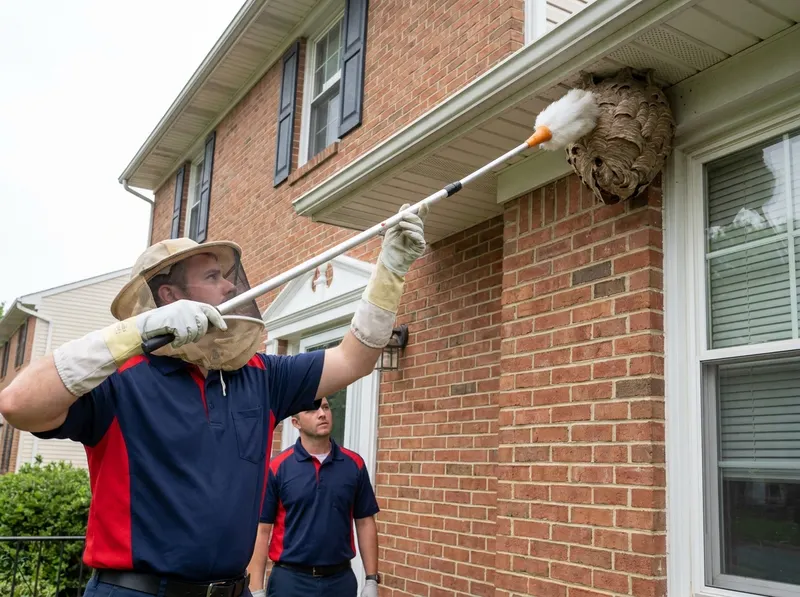
Stinging insect nest removal stops structural colonization before stinging pests compromise living zones. In historic communities like Quaker Hill, Forty Acres, and Cool Spring, aging building materials offer accessible entries for yellow jackets. These insects exploit missing mortar joints, open soffits, and rotted fascia around 19th-century cornices to construct massive void nests behind drywall. In leafier neighborhoods such as Wawaset Park, the Highlands, and Baynard Village, expansive tree canopies and mature shrubbery flanking Delaware Avenue and Rockford Park provide support structures for bald-faced hornet football nests that often measure 14 to 20 inches in diameter. When nests develop undetected inside wall voids, worker wasps can chew through the gypsum layer of sheetrock, leading to active indoor swarms that eliminate household safety.
Immediate mechanical extraction differs fundamentally from casual aerosol treatments. Over-the-counter pesticide sprays irritate active colonies, triggering aggressive defense flights across lawns and driveways without penetrating the dense core layers of a multi-tiered nest. For subterranean yellow jacket colonies, common along foundation perimeters and retaining walls near Brandywine Park and South Brandywine, a directed micro-dust injection reaches subterranean brood chambers that surface sprays cannot contact. Aerial paper wasp nests on 2-story eaves in Trolley Square require specialized telescopic delivery lances equipped with pyrethroid or non-repellent residual compounds to achieve immediate downing followed by complete physical detachment. The baseline trade-off of professional extraction over containment is the requirement for localized exclusion: removing the nest without sealing structural gaps leaves architectural voids open to re-infestation the following spring.
1. Initial thermal and visual assessment isolates the exact point of colony entry, nesting substrate, and structural depth. 2. Protective pressurized application introduces targeted knockdown formulations directly into the primary entrance to neutralize guard wasps and inner comb chambers. 3. Mechanical detachment extracts the physical comb, envelope, and core brood to eradicate biological attractants that lure secondary scavenging pests like carpet beetles and rodents. 4. Exterior entry exclusion seals gaps using copper mesh, silicone sealant, or elastomeric patching. The base service minimum is $300, covering standard single-nest extractions accessible up to 12 feet from grade. Multi-tier nests behind interior finished walls or located above 20 feet carry additional specialized access costs that are confirmed during the initial perimeter inspection.
Every job gets a firm, written price after a free on-site visit.
Tell us about your stinging insect nest removal job in Wilmington and we'll send a clear, written quote, usually the same day.
 Calviro Pest Defense